Return to Native Vegetation Removal Main Page
PROPER NATIVE TREE BARRICADES
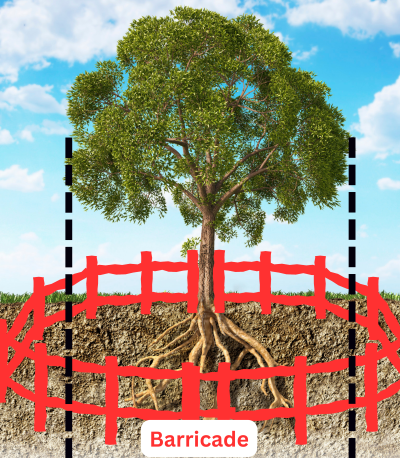
It is important to properly barricade trees and vegetation that is to be preserved in place prior to site construction activities. This will give guidance to the heavy equipment operators during the initial land clearing, protect preserved vegetation from encroachment by construction machinery/trucks during the active building phase, and mark the areas as inappropriate for storing construction equipment and supplies.
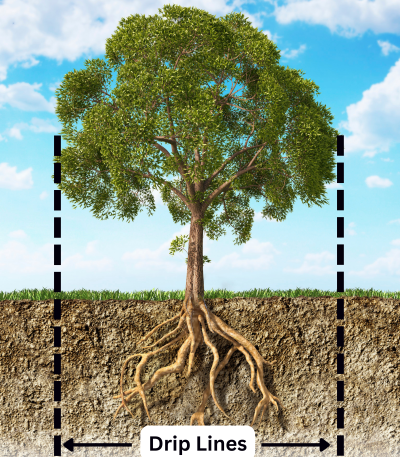
Tree and plant roots can extend out from the center trunk a great distance traveling underground. Protective barricades should be placed around the tree and extend out at least to the
dripline, or rootzone as well as include the associated native shrubs and groundcover.
The
dripline is the area above and underground that is directly beneath the outer circumference of a tree's canopy, where water drips off branches.
For many trees, when the dripline aka root zone is compacted, the tree's roots are subject to breaking and tearing and that stops the flow of water and nutrients to the tree. Changes in ground elevation either by removing soil or adding additional soil within the drip line interferes with soil permeability that alters the tree's essential gas exchange and subsurface drainage. When fill is added to the top of the soil, the supply of oxygen to the roots is decreased substantially and the trees are unable to survive. The damage may be seen immediately or the tree may take several months to show signs of distress before it ultimately dies.